




[This transcript has been edited for brevity and to improve flow.]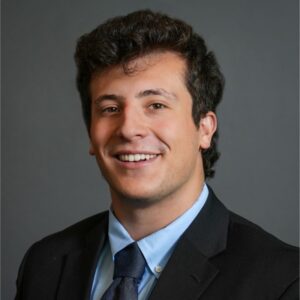
Tom: Jake, congratulations on completing your LSAT this past weekend, and thank you for your willingness to be interviewed for the SPEaconn alumni newsletter.
Jake: It’s my pleasure. Thank you for asking me to interview!
Early Influences
Q: To get started, can you reflect on the early influences—family, mentors, experiences—that sparked your interest in political science, law, ethics, or public service?
A: My great grandmother, Roslyn Montlick, was one of the first female trial attorneys in Connecticut. To recognize her for this feat, her name is on the wall of the New Haven courthouse. She was someone I always respected as she was very stubborn and brilliant. I can’t even imagine the amount of courage and perseverance it must have taken for her to become a successful lawyer back in those days.
Her story as well as several other family members who became lawyers opened my eyes to the law. What really grabbed my interest was the court system – especially the U.S. Supreme Court. I became fascinated with the idea that judges can be appointed for life in a democratic system and function as an effective check on the other branches, at least in an ideal world.
In high school, I also got involved in my town’s youth and services board as the youth liaison. The goal of the board is to help with the governance and oversight of Madison Youth and Family services which seeks to provide support, assistance, and opportunities for kids throughout K-12. They think it prudent to give high schoolers representation in the decision-making process, which is where the role of the selected youth liaison comes into play. Most of the members of the board are older, some with kids who have long graduated from Hand High School and others who may be in elementary or middle school. Since this makes it difficult for them to really understand a lot of the issues and truthfully just lifestyles and differences between the generations, the role is an important one if it is treated accordingly. Before I started in this role, one of the members of the board met with me to explain the opportunity I had to make a real difference, which I was determined to do.
As a result, I took this opportunity seriously and focused more on helping kids make healthy choices rather than on the negative impacts of using substances. Realistically – kids will drink and smoke and make bad decisions, so I felt it was better to influence the direction of their lives rather than focusing on total prevention. It’s so important to understand that going at things from this rigid and unmovable stance often is an unsuccessful approach and does more harm than good, especially when dealing with kids who are struggling to figure out who they are and why they may do things they are doing. To build community around someone, you must come from a place of empathy, understanding, and acceptance if you want them to value your perspective and anything you might have to say about things they could do differently or better.
This experience highlights my passion for making a difference in people’s lives, and the amazing feelings that come with this sense of purpose. It also led me to start the Unity Club in high school that really focused on the idea of unifying people, rather than taking the stance of focusing on one specific form of diversity among us as kids and students, just appreciating and embracing everyone for who they are and what they stand for. We worked on creating “passion projects” – projects that sparked people’s true passions as self-motivating interests that had a positive impact on others, like cleaning the town beaches, creating a proposal for a youth center, working on getting more youth representation in town boards, working with school the administration on the dress code policy etc. As the founder and leader, my role was to help these kids build their networks, which I found extremely rewarding as I was in this community-engaged role with tons of resources and access to town leaders, so they could accomplish their goals.
Another mentor on the youth services board, John Michael Parker, ran for Connecticut state representative and is still serving to this day. While working on his election campaign, we discussed ways for him to not just get the youth vote, engagement, and support, but how to really help them feel like they were on board with what he stood for. As such, we expanded the passion project idea into part of his campaign, creating a sort of internship where he further helped match kids with interests and connect them with leaders who specialized in these areas. This was also my role in the campaign as I helped gather the kids for this and also helped with providing that key youth perspective on a lot of his youth-oriented political stances. This was during the time of increasing political partisanship, so we helped his team focus on unity and moderate political stances.
Academic Journey
Q: Your senior thesis, “Breaking Precedent: Reimagining Judicial Ethics in the U.S. Supreme Court,” signals a deep interest in judicial integrity. What prompted you to choose this topic, and how has your research influenced your perspective on law, public policy, and ethics?
A: The ongoing ethical issues facing today’s Supreme Court (SCOTUS) is one of the biggest inspirations for my thesis. However, I also knew I wanted a topic broad enough to allow me to focus on other emerging issues. So, I also included a comparison of SCOTUS to high courts in other peer democratic nations. Having this context provided me with a whole different level of understanding of how courts operate, and whether SCOTUS is backsliding to the extent that the media often portrays it to be. While each court has its own unique components, for example, Germany’s high court has the power to disband political parties based on the Nazi experience, the courts I studied were all the final interpreters of their nation’s constitutions, they were all appellate courts, and they all served as a check on the other branches of government.
My findings really highlighted that each of these courts has faced ethical controversies in the past. This is not an issue that we face alone, but the differences I could identify were in the responses. It is a very delicate issue to consider as these courts play a fundamental role in their nations with their interpretative authority of the constitution, but also as a check on the other branches of government. This is why it is difficult to come at reform from a legislative perspective and why it is crucial that SCOTUS regulate itself better and create stronger foundations of the institution to ensure its continued legitimacy in the eyes of the public.
UConn Transformative Experiences
Q: How did your time at UConn—inside and outside the classroom—shape your intellectual growth and personal development? Are there particular professors, classes, or experiences that had a lasting impact?
A: One of the first classes I took at UConn was Honors Biology. One of the things I loved about my professor, Professor Abbott, was how he explained both the way the COVID vaccine worked and why this was important for public health. It was a really cool connection between the theoretical and the practical, especially during a time when the disconnect was incredibly apparent and causing real world issues. It really highlighted to me how important it was for those in positions of power to connect in real time with the general public, not just push out scripts and narratives that don’t really explain much or assume people can’t understand or just not even give them the opportunity to understand.
Another one of my favorite classes was about cybersecurity and how this whole topic has evolved over time. My professor, Professor Arthur House, really opened my eyes to the challenges people are facing on how to handle cybersecurity. For example, the role of AI, what types of retaliatory responses to cyber-attacks are appropriate in terms of physical warfare. Unlike traditional military responses, it is difficult to react to a big cyber-attack that is proportionate to the impact – a standard the international community has relied on since the establishment of the international rules-based order and the National Security Council (NSC). For example, some cyber-attacks can be extremely deadly and costly like a cyber-terrorist attack on a hospital, water supply, or the electric grid. Professor House was amazing in that he had real world experience in the field of national and cyber-security (as he was a former employee of the NSC) and he still works in making sure our country is safe and the future leaders of tomorrow are well versed in how to understand these massively important concepts. He worked with Kissinger, Scowcroft, Poindexter, Brzezinski and more, and really integrated all these incredible stories into the classroom. That course made me feel really lucky to be at UConn and learning from someone as cool and important as that.
My Politics of Crime and Justice professor, Professor Bergendahl was also my thesis advisor, and I learned so much from her class about something so fundamental to our country – the criminal justice system. I had never really learned much about how these things worked from the police to the prosecutors to the courts to the parole sides of the system and learning the applicable case law from SCOTUS also really solidified my interest in the class as this is something I am passionate about.
Sigma Phi Epsilon Involvement
Q: Can you describe what first drew you to join SigEp? What did you contribute to the chapter, and what did you gain from the brotherhood experience?
A: When I first moved to UConn I lived in an honors dorm, which did not have much of a social life. So, when I saw the Balanced Man Scholarship I applied and met Robbie du Toit who was the chair for the Balanced Man Scholarship (BMS) at the time. He really helped get me from an applicant to actually investing in learning more about SigEp. Ultimately, it was at the BMS banquet after I heard the way that (Jonathan) Wharton described the Fraternity that made me want to join the organization and give it a try. What he said really stuck with me – that this Fraternity is different – that they really do some cool things like the BMS program, Tragos, and Ruck. SigEp has all the benefits of a social organization as well as a professional organization – not to mention all of this was coming from a guy who is a Renaissance brother and joined after graduating and now a professor at a different school in a whole different part of the state yet still made the time to come and speak that night about SigEp.
After I joined, Robbie talked me into getting on the Recruitment team, and I picked up the BMS Chair position. It was a good learning experience, so that fall I ran for the VP – Recruitment (VPR) and VP – Member Development (VPMD), and I lost both races. It felt like a slap in the face, but I took it in stride and sought out feedback by reaching out to guys who previously were in these positions, brothers in leadership positions, and other guys that had just simply listened to my speech and listened to the deliberations.
After the election, I decided to attend open Exec weekly, and saw the inner workings of the chapter and identified ways I could help out and opportunities I might be able to take advantage of. Under Mike Quinn, who had bested me for VPMD, I was a Phi challenge coordinator and an Epsilon challenge coordinator – both of which gave me a really good sense of those BMP challenges and what I saw as ways to improve them. I was also determined to improve BMS in my second year as the chair, where I had more influence over the process and a better grip on timelines, interviewing, and overall function of the scholarship. What I really learned was to find guys during the BMS recruitment process who were already living our Cardinal Principles without knowing it – something I personally identified with as a former BMS winner and that I now saw as a way of finding guys like me who just needed to know that this fraternity is different. The guys we wanted needed to be well-rounded and balanced, and we must show them that we provide cool growth opportunities that allow guys to really grow while also being a social fraternity.
Another key lesson I gained from SigEp was the realization that the VPMD is what really makes SigEp different fundamentally. No other organization I’m aware of at UConn has this role – most of them have a pledge master or a VP who handles new member education, but none of these organizations actually provide valuable development to members past their new member ed phase.
Legacy within SigEp and UConn
Q: As you move forward from your undergraduate years at UConn, what legacy or values are you most proud of passing on to younger SigEp brothers?
A: Figuring out how the various leadership roles in the Fraternity worked and relating these roles to each other allowed me to revolutionize the Balance Man Scholarship program and the Balanced Man Program. I hope that the ways we have improved these programs and the scholarship will remain in place long after I am gone and continue to be adapted and evolved into even better processes. The things we do have not only have to match in terms of what we practice and what we preach, but they also need to work for us in a positive way. If things aren’t working the way they should be or if there are things that are falling off, it’s a sign that we need to take time to reevaluate and reassess what we are doing and how we can get things back on course. Because I had such a unique role in the Fraternity as a former BMS winner turned BMS chair, I used my Brother Mentor project to create a BMS Guide with the idea of making sure the scholarship could continue to be done properly and well but also with the idea of growth and better ways of getting it done!
Advice and Reflection
Q: Finally, what advice would you offer to your fellow SigEps who may be navigating their own journeys—balancing academics, service, and leadership—as they prepare for life after graduation?
A: You can’t get down when things don’t go your way. In my case, I lost two elections. You have to lick your wounds and realize there are a lot of guys that make the chapter better who are not on the Exec board. I realized that to get on the Exec board, you need to help the rest of the chapter – people need to see you are committed to making the chapter better. I only wish I became more active in the Fraternity sooner than I did, which would have allowed me to get to know both the older guys as well as the younger guys. Think about how many guys you can meet through this fraternity if you are a member for all four years. You want to be able to look back one day and be content with the time you spent in college. Use the time you have the right way because we ultimately do not know how much time we have with each other. The decision to join the Fraternity was a mutual one – the Recruitment Committee chose you and you chose the Fraternity – this was a mutual understanding that we both like what we see in the other – you cannot lose sight of that. In every place you go, person you meet, and organization you join, there’s an opportunity to make an impression that will be positive and lasting. Take advantage and make your name known. Who you are is now a reflection of not just your own values but also those of the fraternity and, however cliché, the meaning signified by the letters of Sigma Phi Epsilon. Leave a mark that you can look back on in 10, 20, or 50 years and say “damn proud.”